
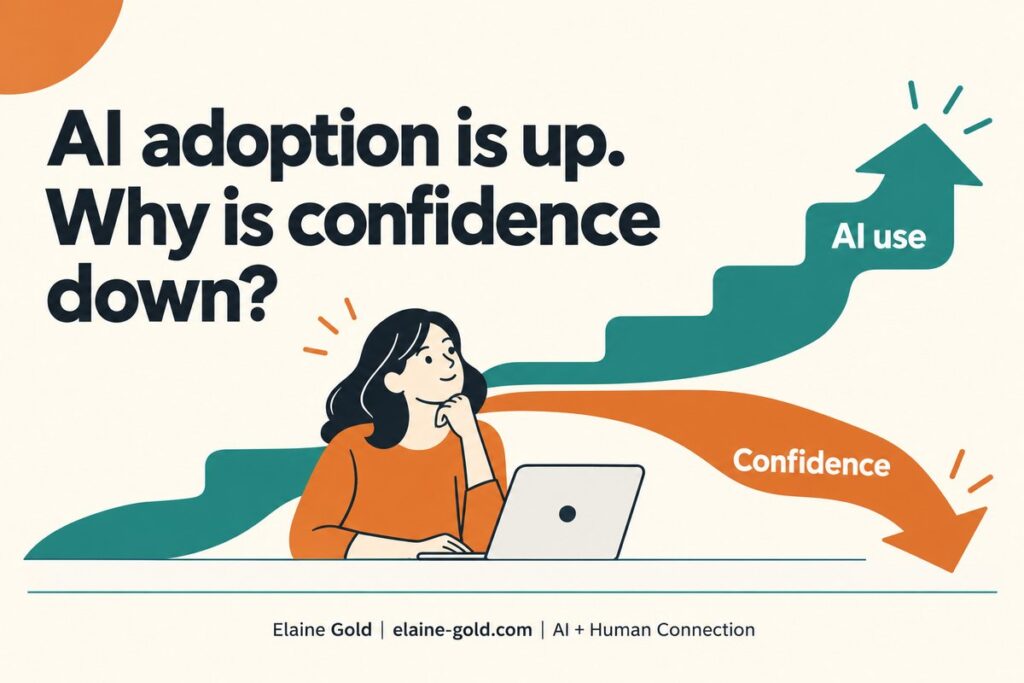
I have had some interesting conversations this week, with clients and with other people working in the same space as me. Many of them are using AI more and feeling less confident.
The same thing keeps coming up. Organisations have rolled out AI, but take-up is slower than they expected. Some are struggling to see what they are getting back from the investment.
When I talk to team members, there is still a big gap between having access to AI and feeling comfortable using it at work. People are unsure where to start, what they are allowed to share and whether they should trust the answers.
I hear similar worries from solopreneurs, small business owners and founders. You are already running a business. Finding time to learn another tool, when the features seem to change every week, feels like another job.
And when we feel uncertain, we sometimes freeze. We put things off until we feel better prepared. The trouble is that waiting does not give us the experience we need to feel more confident.
What the research says about feeling less confident
The research backs up some of what I am hearing. PwC’s 2026 survey of nearly 50,000 workers found that AI use at work had risen by ten percentage points. Yet the share who say they have the learning and development resources they need fell from 59% to 51%. Those resources cover learning more broadly than AI training, but the direction concerns me. We are asking people to adapt while access to support falls.
ManpowerGroup’s 2026 research also found AI use rising while confidence in using technology dropped. More than half of workers reported no recent training, and 57% had no access to mentoring.
If we want AI to help businesses grow, people need to feel confident enough to use the tools thoughtfully. That deserves more attention.
Start with one small task
That starts with something manageable. Choose one familiar, low-risk task. At home, you might ask AI to help plan meals from the ingredients you already have. At work, try turning your own non-confidential notes into a draft agenda. Use an approved tool and keep personal or sensitive information out.
Then look at the answer. What was useful? What did AI misunderstand? Change your instructions and try again. You are learning how to work with the tool, rather than expecting a perfect answer first time.
This is why I start my workshops with the right tasks, the right tools and the right instructions. People need a starting point that is relevant to their own work. A demonstration feels far more useful when you recognise the problem it is solving.
Follow-up matters too
Once you have tried a task yourself, you will have different questions from the ones you had in the workshop. A mentor, a colleague or a small peer group gives you somewhere to talk those questions through. People who feel less confident often benefit most from this kind of follow-up.
If you manage a team, have a conversation with HR about a training plan aimed at building confidence across the workforce. Start by asking people where they feel unsure. Give them time to practise on tasks from their own roles, explain the boundaries and arrange support after the session.
Then check progress through the work itself. Has preparing an agenda become easier? Does the person know how to check a summary? Are they clearer about when to ask for help?
If you work for yourself, give your own learning some space in the diary. Twenty minutes practising one useful task is a sensible place to start.
Want to talk it through?
If you would like help working out where AI fits in your own work or your team’s, book a free 10-minute call with me. It really is only 10 minutes, and it is not a sales pitch. I would like to hear what you are trying to do and see whether I can help.
